Why Your Bathroom Looks Like a Different House (And How to Fix It)
You walk from your living room into your bathroom and it feels like you crossed a border. The living room has cohesive warm wood, a layered rug, art that ties the palette together. It feels finished. The bathroom has white subway tile, a chrome faucet, and the vanity that came installed in 2014. Nothing in the bathroom would have been chosen by the person who chose the living room.
Most bathrooms feel like this, and the pattern repeats in nearly every whole-home project we take on at Debora. The kitchen gets the design budget. The living room gets the personality. The bathroom gets value-engineered, copied from a Pinterest board that has nothing to do with the rest of the house, and finished by whichever contractor was free.
The result is a room that works fine on its own but reads "orphaned" the second you walk in from anywhere else in the home.

This is fixable. Not always with a renovation, and almost never with new tile. What fixes it is borrowing material from somewhere else in the house and putting that material in the bathroom on purpose.
To make the rule concrete, the rest of this post walks through one home we designed end-to-end (the Contemporary Custom Home) and pulls the threads we used to tie every bathroom in it to the rest of the house.
What makes a bathroom feel like part of the home
A bathroom belongs to a home when at least three material threads carry through from somewhere else in it. One thread is a coincidence. Two is a maybe. Three is what reads as designed.
A material thread is any choice that physically repeats: the wood species of your floor, the metal finish of your kitchen hardware, the stone of your fireplace, the paint color of your bedroom wall, the pattern of an accent wall in your dining room. When a bathroom carries none of these, your eye flags it as foreign before you can name why.
1. Match the wood species, not just the wood tone
If your kitchen cabinets are walnut, the bathroom vanity should be walnut. Same species, not "wood-colored." White oak and walnut look identical online and entirely different installed.
This is the easiest thread to add and the most often skipped, because bathroom vanities get picked from a different vendor's catalog than your kitchen cabinets. The wood looks right in the showroom. It will not read the same at home.
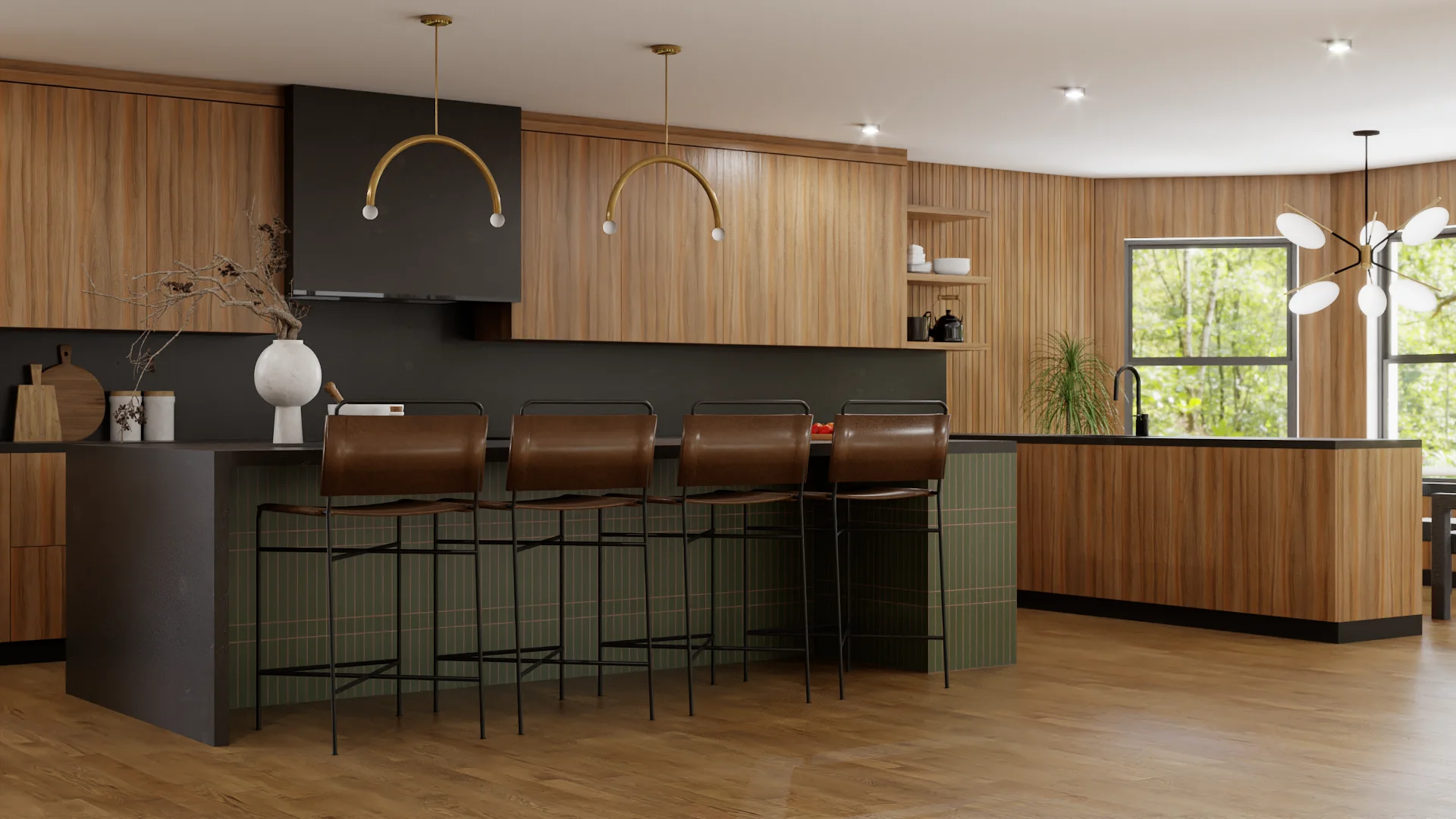
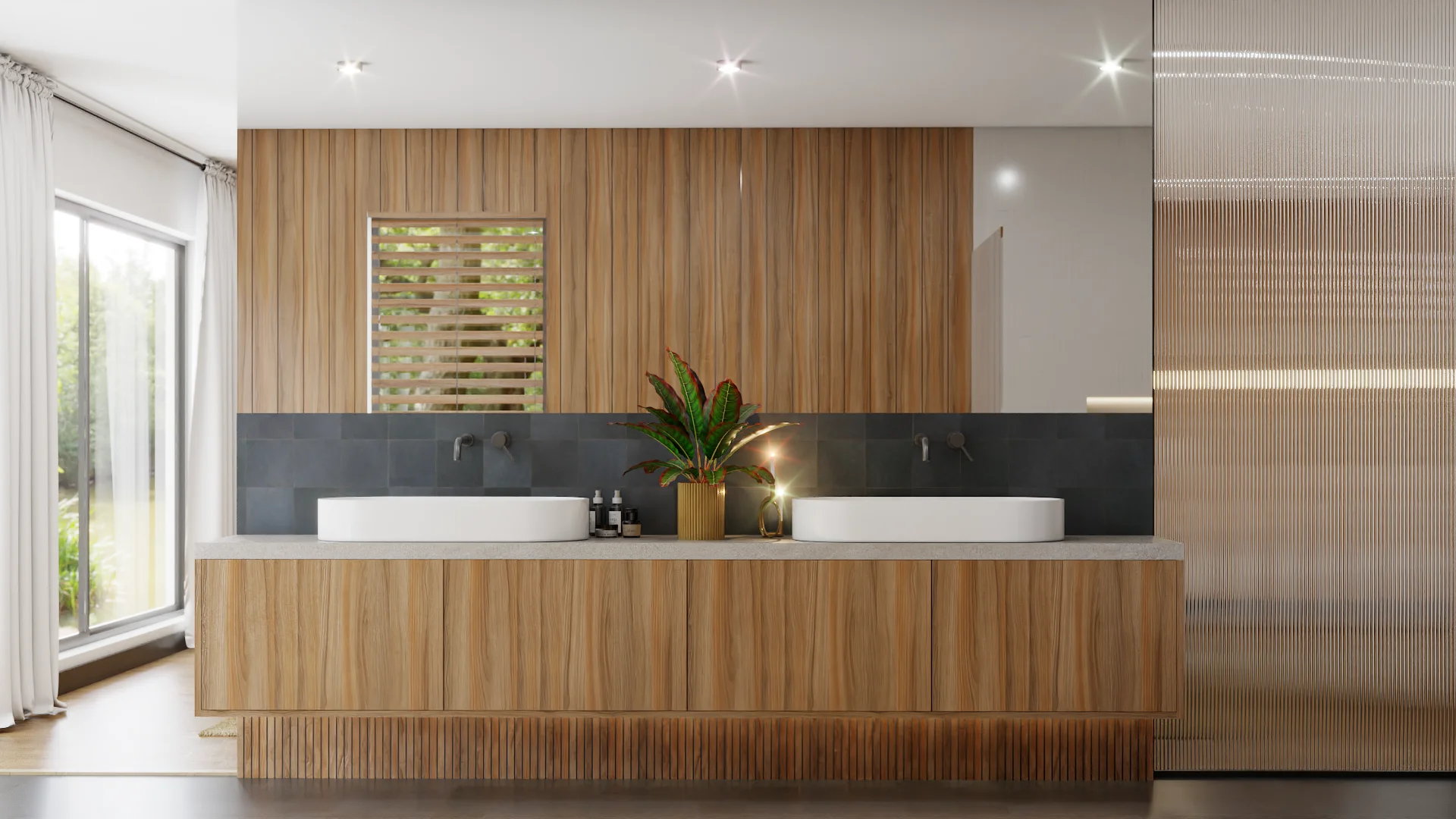
In the Contemporary Custom Home, walnut runs through the kitchen cabinetry, the living room plank ceiling, the bedroom panel walls, and the bathroom plank wall behind the tub. One species, four rooms, one thread. The bath did not have to work hard to belong, because the wood did the belonging work for it.
2. Pick one metal finish for the whole house
Brass, black, chrome, nickel. One. The brass on your kitchen faucet should be the brass on your bathroom faucet. The black on your dining chandelier should be the black on your bathroom sconces.
Most homes fail this because the bathroom hardware was selected by the plumber, not the homeowner. Plumbers default to chrome. If your kitchen is brass and your bathroom is chrome, you have two metal languages in the same house. The eye reads inconsistency as cheapness, even when nothing on its own is cheap.
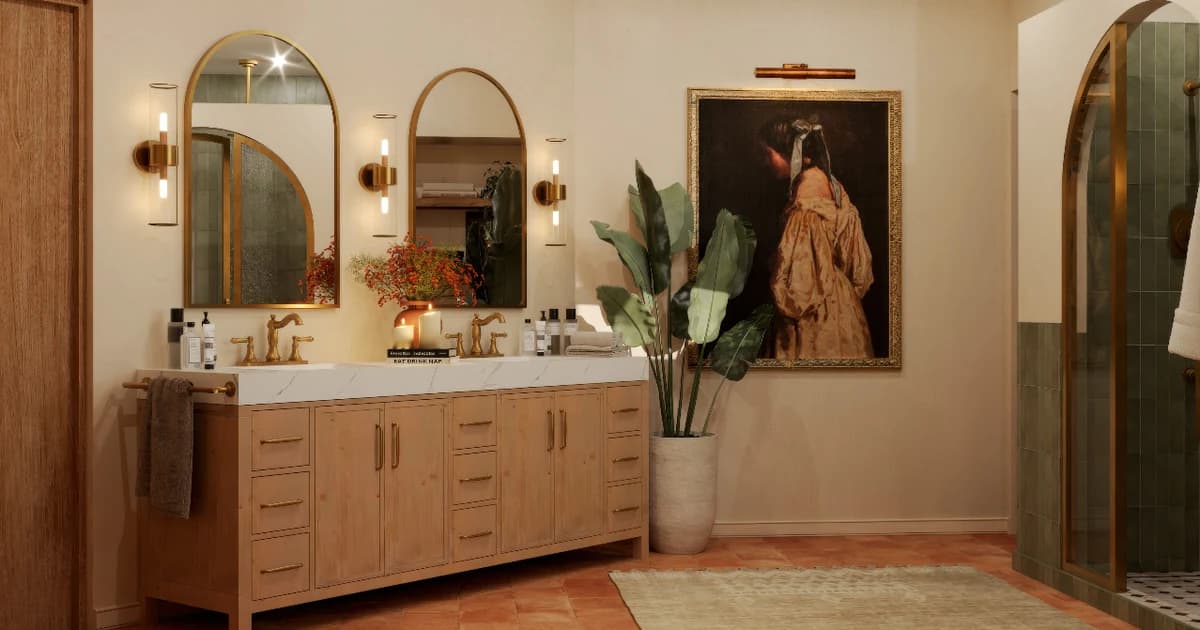
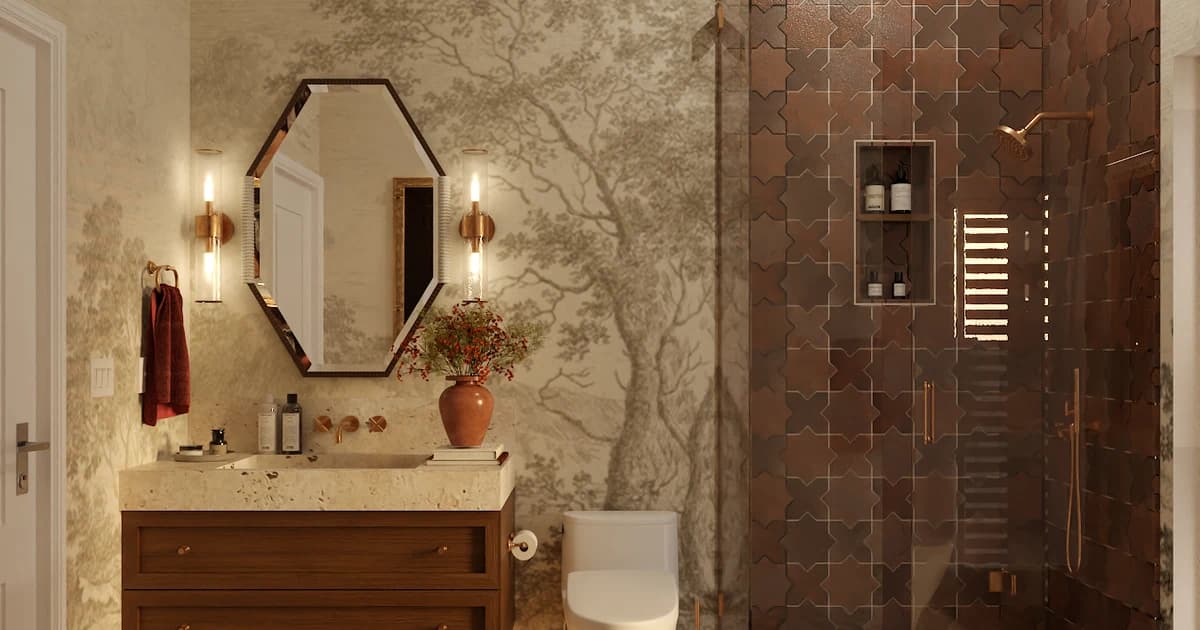
In the Contemporary Custom Home, brass appears in the kitchen pendants, the bedroom sconces, the gold mirror frames, and the bathroom fixtures. One finish across every metal touchpoint. The bathroom inherited the metal story instead of inventing its own.
3. Run the fireplace stone into the bathroom
If you used a specific stone on your kitchen island or your fireplace surround, repeat it in the bathroom. The stone you chose for the showpiece room of the house is the stone the bathroom borrows from.
This thread has the biggest visual payoff because stone is what the eye lands on hardest in a bathroom. A bathroom dominated by white subway tile reads as "default bathroom." A bathroom dominated by stone that echoes another room in the house reads as "the bathroom of this house."
The Contemporary Custom Home uses slate in the master bath and the double-vanity guest bath, with a stone fireplace wall in the living room carrying the same cool gray temperature. Two stones, one palette, every room in conversation.
4. Borrow an accent color from another room
If your living room has a kilim rug, pull the kilim's warm tones into the bathroom. If your bedroom is sage, paint a bathroom wall sage. Take an accent color that already lives somewhere else in the house and let it land in the bathroom too.
Most people skip this because they think bathrooms are supposed to be neutral. Beige walls, white tile, gray grout, the bathroom palette of a hotel. Hotel bathrooms are neutral on purpose because hotels do not want any room to feel personal. Your home is the opposite brief.
5. Repeat the pattern your living room uses
If you have a tile pattern, a wallpaper, or a walnut slat wall that defines another room, repeat it in the bathroom. Walnut slat in the living room wants to be walnut slat behind the tub. Wainscoting in the bedroom wants to be wainscoting in the powder room.
The mistake is treating each room as its own pattern problem. Picking a kitchen tile pattern, then a separate bathroom pattern, then a third for the laundry. Three patterns competing across three doorways is what makes a house feel pieced together. One pattern stretched across rooms reads as a thesis.
In the Contemporary Custom Home, walnut slat shows up in the living room fireplace wall, the third bedroom, and the master bath. One pattern across three rooms reads as a deliberate language.
6. Match the bulb temperature room to room
The bulbs in your bathroom should match the bulbs in the rest of your home. Warm 2700K everywhere, or 3000K everywhere. Not warm in the living room and cold in the bathroom. The bathroom that reads "hotel hallway at 2am" almost always has 4000K daylight bulbs in fixtures specified by an electrician who was not asked which temperature.
The thread you do not see can break the home as much as the threads you do. Walk from a warm living room into a cold-lit bathroom and your eye registers a different building before you register the architecture. Same fixtures with warm bulbs swapped in change the room overnight, no renovation required.
When the powder room should break every rule
Cohesion is not uniformity. The thread rule ties bathrooms to the rest of the home, but interior designers break it on purpose for one room in nearly every project: the powder room.
The powder room is the room guests use and family rarely does. It is small, it has no plumbing connection to bedrooms upstairs, and it is the one space where you can swing hard on a single bold material or pattern without the room reading as a mistake. The powder room is where deliberate contrast belongs.
A primary bath used every day by the family should follow the threads strictly. A powder room used by guests once a month can break one or two threads on purpose, as long as the others hold.
A 3-question test for whether your bathroom belongs
Stand at the threshold of the room. Walk in, walk back out, walk back in again. The first time, you are noticing the bathroom on its own. The second time, you are noticing the bathroom in relation to what is on the other side of the door.
Three questions on the second walk-in
- Is any wood in this bathroom the same species as wood somewhere else in the home?
- Is any metal finish in this bathroom the same finish as metal elsewhere in the home?
- Is any stone, tile pattern, or paint color in this bathroom repeated anywhere else?
Three yeses and the bathroom belongs. One or zero yeses and the bathroom is orphaned. You do not need to renovate to fix this. A new vanity in the home's wood species, a faucet swap to the home's brass finish, a wall painted the bedroom's accent. Three changes, no demo, the bathroom rejoins the house.
How to make your bathroom match without renovating
The bathroom is the easiest room in the house to make feel like the home. It is small, it has fewer surfaces, and the threads you need to add are physical objects that come from a vendor's catalog. You can specify them all in a single afternoon.
The reason most bathrooms feel orphaned is not budget. It is sequencing. The bathroom got scoped last, value-engineered first, and was treated as a plumbing room instead of a design room. When the wood matches your kitchen, the metal matches your hardware, the stone matches your fireplace, the paint nods at your bedroom, and the bulbs match the rest of your lamps, the door stops feeling like a border. It feels like a hallway.
If you want this done for the bathrooms in your house alongside the rest of it, our team designs whole-home projects entirely online, the same way we approached the Contemporary Custom Home shown above. Book a free 30-minute consultation and bring photos of the bathroom and the room next to it. We will tell you which threads are missing in 10 minutes.
Frequently Asked Questions
Answers drawn from 2,000+ projects and real client conversations.