How to Make Your Bathroom Feel Like a Spa: 4 Key Decisions
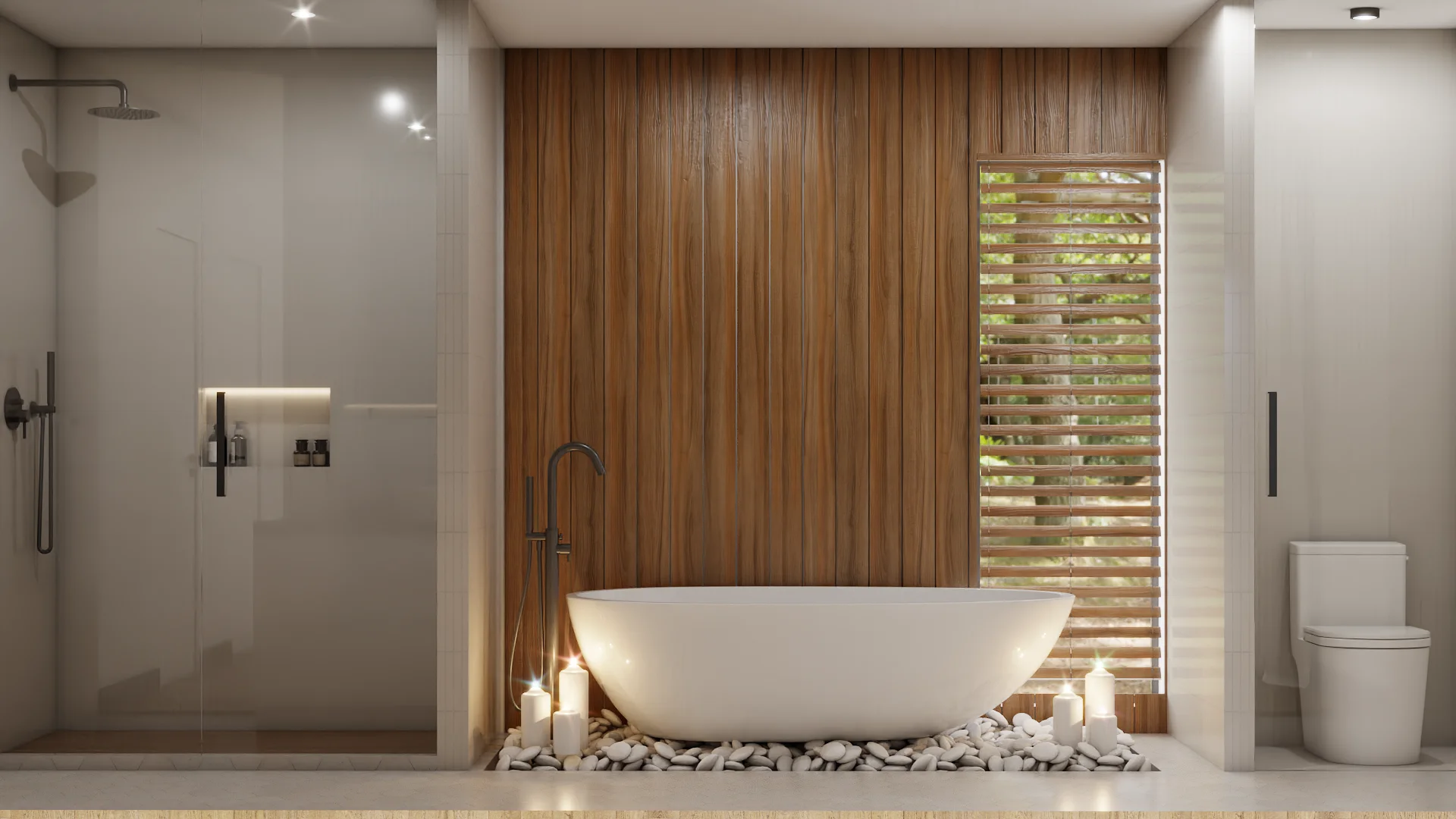
You can buy every fixture on the spa list and still end up in a showroom. Rainfall head, freestanding tub, a stack of white towels folded the way hotels fold them. The room photographs fine. It feels like nothing.
I get asked about this constantly, usually after the renovation is done. The fixtures were never the problem. A bathroom feels like a spa because of its atmosphere, and atmosphere gets decided in the material plan, long before anyone picks a faucet.
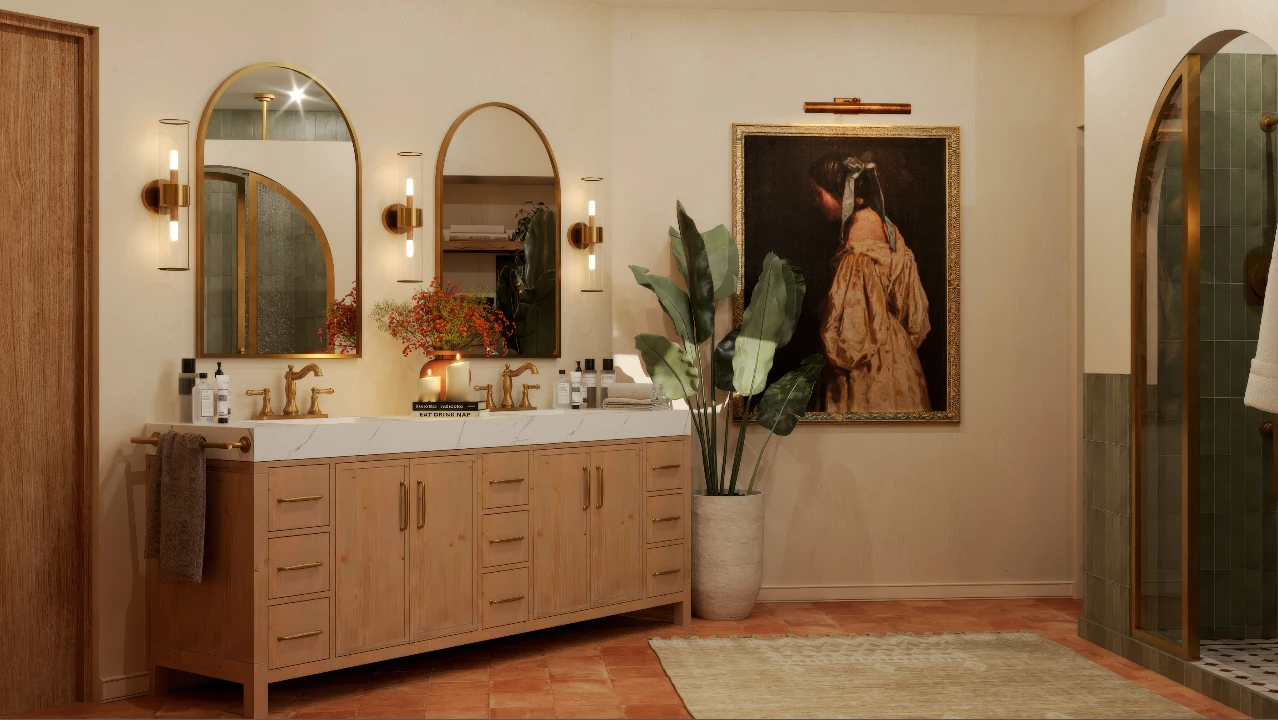
The bathrooms here come from one whole-home project I worked on. Olive zellige, saltillo terracotta, white oak, antique brass. The same four decisions in every room, played at different volumes.
What Actually Makes This Bathroom Feel Like a Spa?
This bathroom feels like a spa because four decisions land at once:
- Natural materials, mixed. Surfaces that behave differently under the same light.
- A repeated curve. One arch, echoed across the room, not a single arched mirror.
- An earth tone palette. Muted colors your eye can actually rest on.
- Layered, low, warm light. Several small sources instead of one ceiling fixture.
Not one of those is a fixture, and not one of them is square footage. A spa does not calm you with hardware. The rest of this guide takes the four in order.
Dora HashaniInterior Designer at Debora InteriorsEvery bathroom I have worked on decided how it would feel in the material plan, not in the fixture catalog. Atmosphere is the first choice, never the finishing touch.
This is why the default all white bathroom so often lands between clinical and unfinished.
Do You Need a Big Bathroom to Get a Spa Feel?
No. The small ones are often better at it.
A large bathroom can carry five materials because there is blank wall between them, acting as a buffer. A small bathroom has no such gaps. Put five materials in it and every surface argues with the one beside it. The rule inverts: fewer materials, repeated more often. One tile, one wood, one warm metal, one floor.
Then carry those four onto every surface they can reach: the wet walls, the tub deck, the shelving, the hooks, the frames. Warm minimalism, doing structural work instead of posing as a look. Even a bathroom that shares space with the laundry can hold the feeling, as long as the machines never become the fifth material.
1. How Do You Layer Natural Materials in One Bathroom?
Mixing textures is the first thing I reach for when a room is technically complete and still cold. Not more objects. More surfaces that behave differently under the same light: one that scatters it, one that absorbs it, one that reflects it, and one you can actually touch. Zellige scatters. Unglazed terracotta absorbs. Brass reflects. A waffle cotton robe on a hook does the touching.
Whether those materials should tie the bathroom back to the rest of the house is a separate question with its own guide. Here I am staying inside one room.
The material mix that keeps a bathroom from going flat
- One handmade tile, like zellige, so the wall catches light instead of reading as one flat sheet.
- One unglazed floor that absorbs light, so nothing bounces glare back up at you.
- One wood with visible grain, on the vanity, a door, or open shelving.
- One warm metal, repeated on every fixture, hook, rail, and frame in the room.
- One soft textile you actually touch: a waffle robe, a rolled towel, a cotton mat.
- One living plant and one handmade vase, so something in the room is imperfect.
Olive Green Tile Walls Over a Terracotta Floor
Olive is the color I use when a client wants green without the room turning into a garden. It sits between the wood and the stone. In a glazed zellige it never reads as one solid block, because each tile catches light at a slightly different angle. The wall shifts as you move past it.
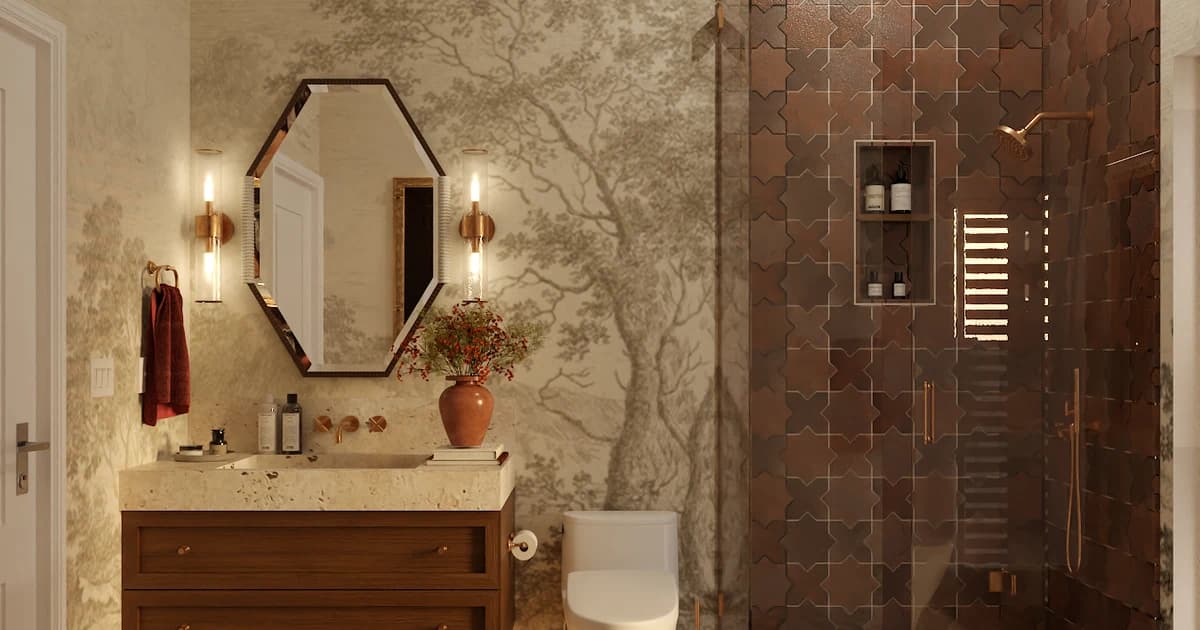
Underneath, saltillo terracotta does the opposite job. It is unglazed and porous, so it drinks light instead of returning it. Green over orange sounds risky on paper. In the room it reads as one family, both muted, both earth, with the warm floor keeping the green from going cold. The material questions, cost and grout and upkeep, are covered where you can see zellige tile in 360 in one of our tour rooms. The same tile reads differently in a warmer register, where a Spanish Revival bathroom runs dark reddish brown zellige floor to ceiling.
White Oak and Brass: The Warm Metal Pairing
White oak is the calmest wood I know. The grain is straight and quiet, the tone pale without going yellow, and it holds its own against a saturated wall instead of disappearing into it. Here it runs across the double vanity, the doors, and the open shelving.
Brass is the other half of that pair, and the finish matters more than the metal. Antique or unlacquered brass has a soft, slightly clouded surface that turns a light source into a glow. Polished chrome does the reverse, handing you a hard pinpoint of reflected light, which is a fine look and the wrong one here. Warm metal, soft glaze, handmade tile. All three soften light.
2. Curved Bathroom Design: Why One Arch Is Never Enough
Every page selling you a spa bathroom sells you an arched mirror. One arch is an object. Three arches is architecture, and only the second one changes how a room feels.
This is the part almost nobody does. A curve you can buy is easy. A curve you have to plan is not. When the shower opening, the mirrors, and the tub alcove all carry the same radius, your eye stops finding edges. There is no corner to catch on at standing height, which is the physical reason a curved bathroom reads as restful.
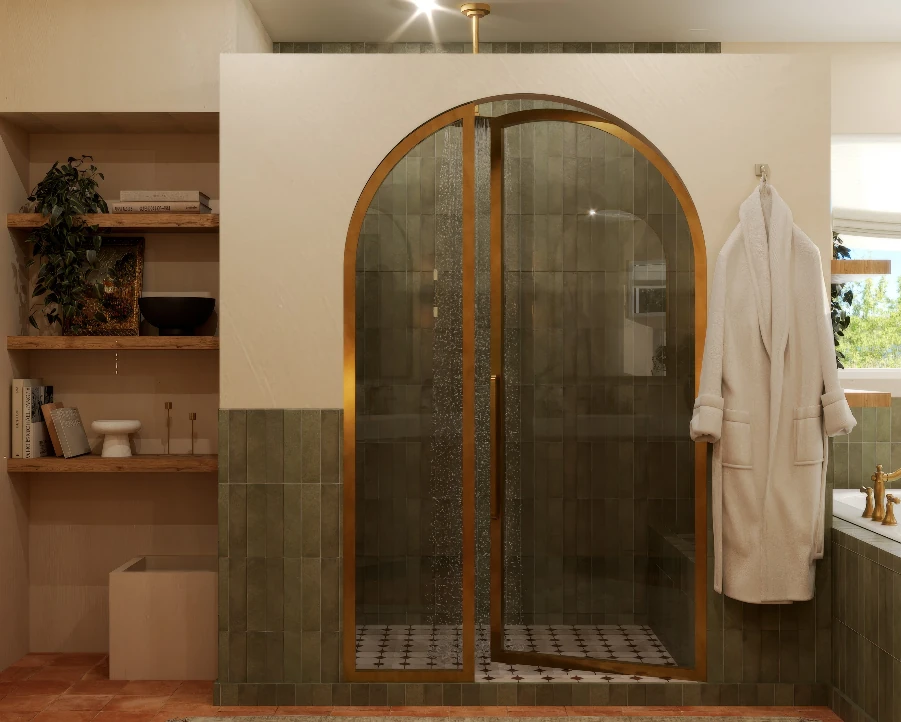
Arch the Shower Enclosure, Not Just the Mirror
The shower is the biggest single gesture available in most bathrooms. Curving the top of that opening changes the silhouette of the whole room. A mirror cannot do that.
In this project the enclosure is a brass framed arch set into olive zellige. The frame draws the shape and the tile fills it. Then the terracotta floor runs straight underneath, which stops the room from turning into a set of bubbles. One tall curve, one flat floor. That contrast is what keeps it architectural.
Arched Mirror Bathroom Ideas That Repeat the Curve
The mirrors answer the shower. They do not compete with it. Over a double vanity I will almost always use two arched mirrors instead of one long rectangle, because two curves at eye level echo the curve across the room and split the wall into a rhythm.
Keep the frames in the same metal as the shower and the radius close, so the shapes read as relatives. If the vanity takes one mirror, repeat the curve somewhere else at another scale: an arched niche, a round tray, the curve of a rounded vase.
Where Curves Belong (and How to Add One Without Construction)
Curves belong on openings, mirrors, niches, and the small objects on a counter. The vanity front, the counter edge, and the tile layout stay square. You need those straight lines, because a curve only reads as a curve when something rectilinear sits next to it. A room where every element is rounded stops feeling calm and starts feeling like a spaceship. Kept to the openings, a curve is a Modern Transitional move that stays legible for decades.
You do not need a contractor for the first one. Swap a rectangular mirror for an arched mirror in a warm metal frame, then repeat the shape in things that are not attached to the building: a round stool beside the tub, a rounded wood tray, pottery with a real belly to it.
Even the shower curtain rod counts. A curved rod pushes the fabric out and softens the hardest rectangle in the room. Four soft shapes in a rental will outperform one renovation you cannot afford yet.
3. Spa Bathroom Colors: Why Earth Tones Feel Calmer
Earth tones feel calmer because they are colors with dirt in them. Every one has been muted with brown or gray, so none of them sits at full saturation or asks for your attention. Your eye can rest on a muted color. It cannot rest on a pure one.
The other half is temperature. Olive, terracotta, ivory, white oak, and antique brass all sit on the warm side, so they agree with the light from a candle, a lamp, or a low sconce. A cool gray palette needs bright, cool light to look right, and nobody wants bright and cool at eleven at night.
The same logic runs through another spa bathroom design in our portfolio, where blonde wood and living green carry the room the way olive and terracotta carry this one. Different values, identical thinking.
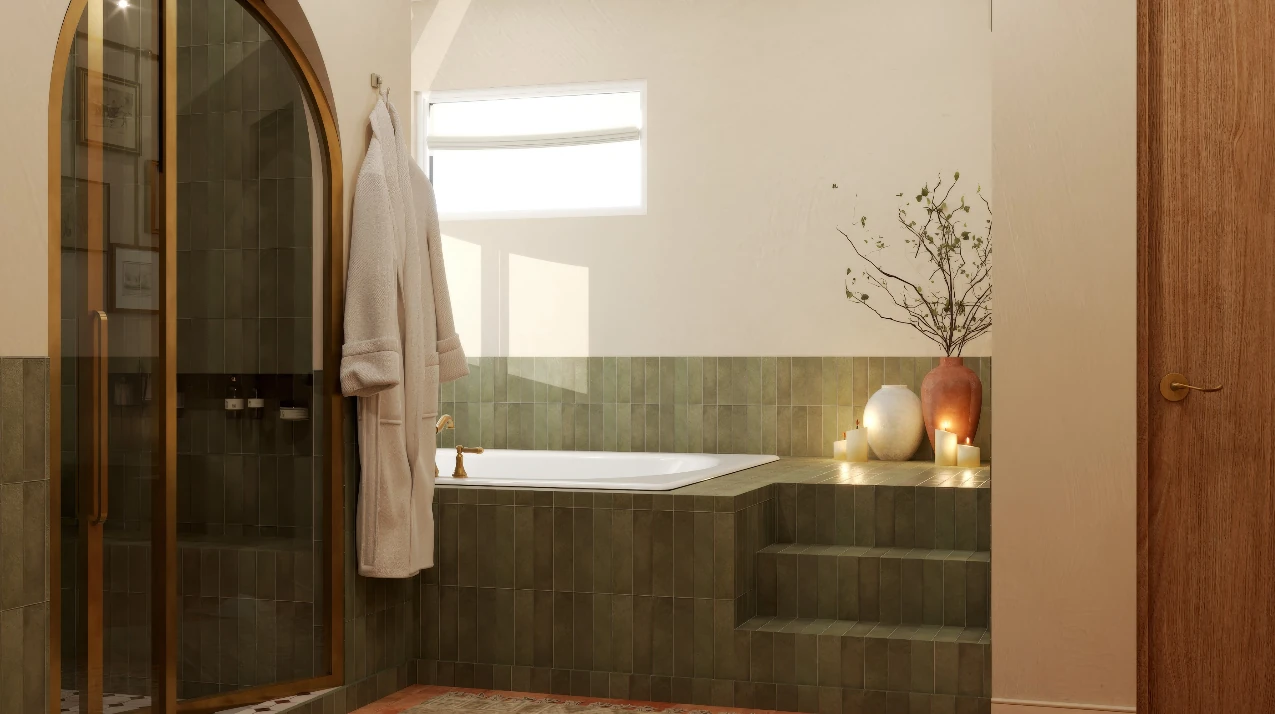
The Palette in This Home
Six values, and only two of them read as color. The olive and the terracotta carry the room while the plaster, oak, and brass keep it from tipping into a theme.
Earth Tone Bathroom Palette: What to Put Where
Put the saturated color on the wet walls. Olive zellige earns its place there and nowhere else. Put the second earth tone underfoot. Terracotta grounds the room and keeps the green from floating. Warm plaster takes the dry walls. It is the quiet field that lets the other two be interesting, and it holds a soft shadow that flat paint cannot.
Put the wood at hand height. Vanity, doors, shelving, stool: the pieces you touch should be the pieces with grain. The metal goes everywhere, in small amounts: faucets, mirror frames, sconces, hooks, the shower frame, the art rail. Brass is the through-line that stitches the other four together.
4. Spa Bathroom Lighting: Sconces Instead of One Ceiling Light
One ceiling fixture is excellent for finding a dropped contact lens. It is terrible for everything else. It drops light straight down, shadowing your eyes and flattening every material you chose. Spa light comes from the sides and from below, at the height of the person in the room. Four small sources, all warm, all on dimmers.
The full framework, what each layer is for and how they stack, sits in our guide to how the lighting layers work in any room. Here I only care about where the fixtures go.
- Vertical sconces flanking the mirror, not a bar above it
A bar above the mirror throws light down onto your face and puts a shadow under your brow, nose, and chin. A pair at the sides lights both cheeks evenly and reads as part of the room instead of part of the plumbing.
- Indirect light under the vanity
A warm strip tucked behind the toe kick washes the floor and makes a heavy cabinet look like it is floating. It is also the only light anyone wants on at two in the morning.
- Lit niches in the shower and over the tub
A lit niche turns storage into a light source. The glow lands on tile at close range, which is exactly where zellige does its best work.
Vertical Sconces Flanking Each Mirror
A pair of tall, slim sconces on either side of the mirror is the highest value lighting decision in a bathroom. Light arrives from both sides at once, filling in the shadows a downlight creates instead of deepening them. You look like yourself. Everyone notices, almost nobody knows why.
Mount them so the light lands at face height, on the same eye line I hang art, roughly 60 inches from the floor. On a double vanity, three sconces across two mirrors works beautifully: one at each outside edge, one shared in the middle. The rhythm matches the two arches above them.
Lit Niches and Light Under the Vanity
The second tier is the light you never look at directly. A lit niche in the shower, a small fixture over the tub, a strip under the vanity. None of them is bright enough to work as a task light, and none of them is trying to be. What they do is put glow at low and mid height, which is how every good hotel spa is lit and how almost no home bathroom is.
The principle behind all of them is worth keeping: the light belongs on the wall, at the height of the thing you want lit, never on the ceiling. The powder room in this house runs on that rule alone, two brass lantern sconces and no ceiling fixture at all. Add candles on the tub deck and you can use the room with the overhead off entirely. That is the goal.
How Do You Add Personality Without Losing the Calm?
Almost every article on this subject tells you to declutter. I would tell you the opposite. A room with nothing personal in it is not calm, it is vacant. Your eye knows the difference immediately.
The discipline is not removal. It is repetition. Two vessels instead of nine, one wood tone, one metal, one kind of frame. Books and pottery on open oak shelving, a robe on a hook because you use it, candles that have actually been burned.
Art in a bathroom feels wrong until you see it done. Then every bathroom without it looks unfinished. A portrait under a small brass picture light, or a row of pencil sketches on a brass rail beside the tub, gives the room a point of view.
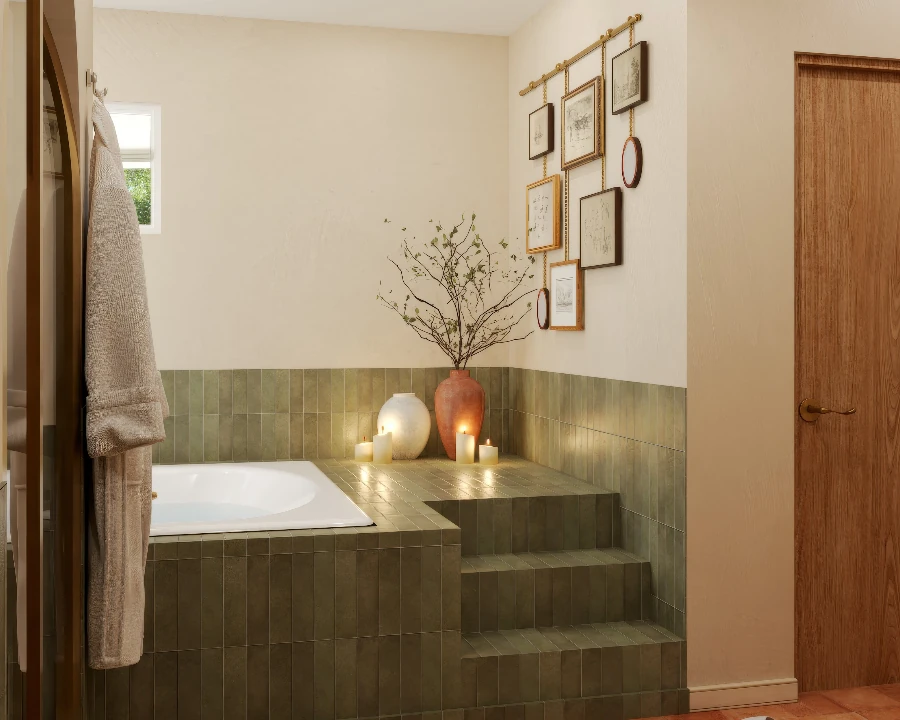
Hang the frames, light the candles, keep the vessels you actually use. The calm survives all of it.
Will an Earth Tone Bathroom Date Faster Than White?
No, as long as you are honest about which layer is permanent and which one is not.
Stone counters, white oak, terracotta, antique brass. Those materials have been in houses for centuries. Nothing about them expires. The saturated layer on top is the part designed to move. Olive zellige on the wet walls is the largest commitment and the most contained one. If you want it quieter in fifteen years, you retile one shower surround. The vanity stays. The floor stays. The brass and the mirrors stay.
The all white bathroom people choose to avoid that risk dates too. The grout yellows and the fittings go out of production. Neutral is not the same as permanent.
How to Plan Your Spa Feel Bathroom Online
We design entirely online, and the sequence is simple. You send photos and measurements of the bathroom you have. The room gets built in 3D with the real tile, the real wood, the real fixtures, and the real light. Then you walk through it. You see the arch at full height and where the sconces land before a single hole is drilled. If the green is wrong, we change the green that week instead of after the tile is set.
Our 360 bathroom tours let you look up at the arch and around at the tile. For how these four decisions land across other rooms and palettes, our bathroom design ideas are the fastest way to look.
See what four decisions look like in a finished room
Every bathroom in our portfolio was planned in 3D before a single fixture was ordered. Look through the rooms first, then tell us about yours.
Start with the materials. Then one curve you can repeat, then a palette with earth in it, then the light. Do those four in that order and the fixtures almost choose themselves. Spend ten minutes in our portfolio. The same four moves show up in rooms that look nothing alike.
When you are ready to plan yours, book a free 30-minute consultation. Send the bathroom as it stands today, bad lighting and all. I would rather talk about how you want the room to feel than about which faucet you were considering.
Frequently Asked Questions
Answers drawn from 2,000+ projects and real client conversations.